
Charting Your Course Through the Sea of Players
Having grasped the essence of business’ existence and the critical importance of value chain in turning raw materials into valuable products, it’s time to turn your attention towards the market and industry you aim to enter.
This stage is about laying the groundwork for your business, akin to observing the conditions of the sea prior to your voyage, by gaining a deep understanding of the marketplace.
Key questions to consider include:
.
- What is a market?
- Who are the major players in my industry?
- On what basis should I evaluate these players—size, location, or customer base?
- How do the roles and strategies of these key players influence each other within the industry?
This article will provide you with frameworks and tools to assess your market. You’ll learn how to observe the dynamics of both large and small companies within your industry and figure out how to position your business effectively in a competitive landscape.
What is a market?
Much like the taxonomy that classifies living organisms, every business and its products or services can be organized into a structured hierarchy.

Stockopedia. (2024). Sector Classification. Retrieved from https://www.stockopedia.com/learn/our-data/sector-classification-462793/
At the foundation of this pyramid lies the market specific to a product or service. The term “market” encompasses various perspectives, such as product-based (e.g., the sunglasses market), demographic-based (e.g., the elderly market), or geographic-based (e.g., the Canadian market). Each perspective offers a unique lens through which to understand its makeup.
Ascending the pyramid, the next layer is the industry, which groups together companies producing similar or identical offerings. Industries are often defined by their core business activities. For instance, the pharmaceutical industry comprises entities primarily engaged in researching, developing, manufacturing, and marketing medications for disease prevention and treatment. A widely recognized system for classifying industries in North America is the North American Industry Classification System (NAICS), which aids government agencies, researchers, and businesses in collecting and analyzing economic data.
At the peak of the classification is the sector, the broadest categorization, uniting industries with shared traits into larger segments of the economy. Sectors are typically divided into primary (focused on raw material extraction, like mining and logging), secondary (centered on transforming raw materials into finished products, such as manufacturing and construction), and tertiary (providing services to businesses and consumers, like healthcare and hospitality).
Within each of these levels, further subdivisions can exist, such as sub-sectors or sub-industries, accommodating the increasing complexity of products and services in the economy.
Analyzing Market Dynamics with Porter’s Five Forces
Having established how your products and services fit within a layered structure, let’s delve into frameworks designed for assessing the market landscape.
At this juncture, we revisit insights from Michael Porter, who introduces a valuable framework for grasping the competitive dynamics in your market, known as “Porter’s Five Forces”.

MindTools. (n.d.). Porter’s Five Forces – The Framework Explained. Retrieved from https://www.mindtools.com/at7k8my/porter-s-five-forces
Threat of New Entry
The “Threat of New Entry” measures how challenging it is for new competitors to join the marketplace. This threat is shaped by various barriers to entry, including strict government regulations, large capital requirements, and the advantages of economies of scale enjoyed by established firms.
Take, for example, the utility sector, specifically the electricity market. Creating a utility company involves massive upfront investments in power plants and infrastructure, putting the initial capital requirement beyond the reach for many. Additionally, the utility sector is heavily regulated because electricity is often considered a fundamental need, leading to strict oversight on how it is distributed and priced.
These hurdles typically mean that only entities capable of meeting these demanding requirements, often public bodies or municipalities, can operate in this space, keeping the threat of new entrants low.
Threat of Substitution
The “Threat of Substitution” gauges the market impact of alternative products or services. As the pool of substitutes grows—offering similar benefits to meet the same needs—the threat to current products rises. Key factors include the number of available alternatives, the ease of substitution, and the overall accessibility of these options.
Consider the transportation sector as an illustration. Multiple modes of transport—public transit, biking, cabs—serve the same fundamental purpose: getting from point A to B. However, the rise of ride-sharing services has dramatically heightened the threat of substitution. These services offer a convenient, often more efficient alternative, challenging traditional transportation methods with their widespread availability and ease of use. This example showcases how the proliferation of innovative solutions can shift consumer preferences and disrupt established markets.
Supply Power
“Supplier Power” indicates the degree of control suppliers have over the cost and availability of materials and inputs required by businesses. This power is stronger in markets where a few suppliers dominate, and switching between them is either too costly or difficult.
A prime example is the advanced semiconductor chip industry. These chips, critical for multitude of technological applications, are supplied by a limited number of companies. Given their pivotal role in everything from consumer electronics to automotive systems, the demand is consistently high. However, the scarcity of suppliers and the complexity of manufacturing the chips give these suppliers significant leverage over their customers. This scenario illustrates how supplier power can influence production costs, supply chain dynamics, and ultimately, market competitiveness.
Buyer Power
“Buyer Power” assesses the influence that consumers hold over businesses, particularly in terms of dictating terms, pricing, and the quality of goods or services. This power intensifies when consumers have a wide array of choices to satisfy their needs, enabling them to easily switch between alternatives.
The grocery sector is an exemplary case of a market that exhibits a strong buyer power. Shoppers are presented with an abundance of options spanning various brands, quality levels, and price points for virtually every product category. This wealth of choice empowers consumers, pushing businesses to continuously innovate and adapt to shifting preferences. To mitigate the ease with which customers might switch to competitors, grocery stores often implement loyalty programs. These programs aim to build customer retention by offering exclusive deals, rewards, and personalized shopping experiences, thus attempting to anchor consumers to their brand amidst a sea of alternatives.
Competitive Rivalry
Finally, “Competitive Rivalry” reflects the intensity of competition among businesses within the same market. It serves as a critical measure of an industry’s overall competitiveness, influencing strategies around pricing, marketing, product development, and customer service.
A prime example of a market with high competitive rivalry is the smartphone industry, where giants like Apple, Samsung, and Huawei vie for dominance. This battlefield is marked by a relentless drive to outdo one another through innovation, brand strength, pricing strategies, and feature sets. The necessity to stand out compels each player to continuously evolve, ensuring their offerings meet or exceed the high expectations of today’s tech-savvy consumers.
Conversely, a segment of the pharmaceutical market demonstrates how competitive rivalry can be evaluated lower, particularly for patented drugs. A new patent grants its manufacturer a temporary monopoly, shielding it from direct competition for the patent’s lifespan. This exclusivity allows the company to set prices and control the market for that drug, significantly reducing the competitive pressures typically seen in other industries.
Grasping the nuances and strengths of these forces allows you to strategically position your product or service within the market landscape. This insight enables you to craft a competitive edge, guiding your business towards success in its specific environment.
Market Structures – Exploring the Economic Landscape
Building upon the insights gleaned from Porter’s Five Forces, delving into the economic classification of markets offers a deeper layer of analysis for determining your business’s position in the marketplace.

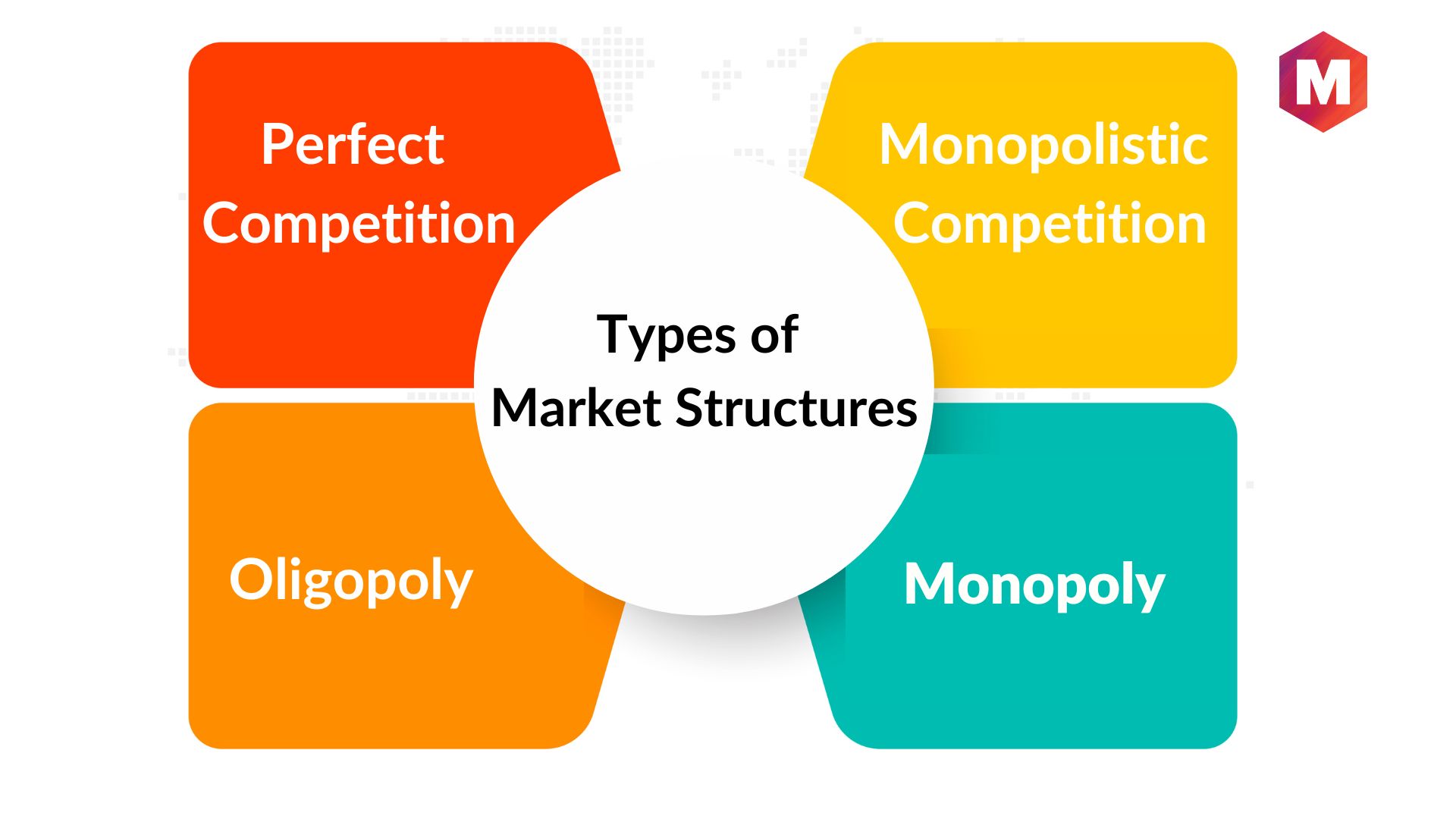
Marketing91. (2023). Market Structure. Retrieved from https://www.marketing91.com/wp-content/uploads/2023/06/Market-Structure.jpg
Here, we introduce four fundamental categories that help describe the various market structures you might encounter. Understanding these distinctions is crucial for fine-tuning your strategic approach and navigating the competitive dynamics effectively.
Perfect competition
A market under perfect competition displays distinct characteristics. Primarily, it hosts a vast number of sellers, each offering identical products. Coupled with perfect information availability, this scenario eradicates any chance for individual businesses to wield pricing power. Consequently, prices are taken as they are set by the market, with no room for negotiation.
The agricultural market serves as a prime example of perfect competition. Farmers produce homogeneous goods such as wheat or potatoes, with no discernible differences between one producer’s output and another’s. This uniformity ensures that no single farmer can dictate the market price.
Monopolistic competition
In a monopolistic competition, a substantial number of businesses operate on a relatively equal footing. They offer products or services that, while similar at their core, are differentiated enough to grant each business a certain level of pricing autonomy.
The restaurant industry perfectly illustrates this type of market. Countless eateries provide food and beverages that fulfill the same basic need but stand apart through unique selling points like branding, cuisine style, ambiance, and more. This differentiation allows each establishment some control over its pricing, distinguishing it from competitors even within the broadly similar category.
Oligopoly
An oligopoly characterizes a market dominated by a few firms that collectively hold significant market share, creating substantial barriers to entry and exit for others. These conditions enable the dominant firms to exert considerable influence over prices, product offerings, and market conditions.
The global petroleum oil market is a classic example of an oligopoly. Only a limited number of companies control a major portion of the oil supply. This concentration of power raises the potential for collusion, where these entities might agree to manipulate market conditions, such as inflating prices, to secure higher profits and strengthen their market dominance.
Monopoly
A monopoly occurs when a single entity exclusively provides a product or service, granting it substantial control over pricing. This dominance means that in the realm of monopolies, competition is virtually nonexistent, allowing the monopolist to set prices largely at will.
While pure monopolies are rare on a global scale, they can occasionally be found in localized markets or specific industries. Historical examples include Microsoft’s dominance in the PC operating system market and Standard Oil’s control over the oil and gas industry, where they once held overwhelming market shares.
However, the presence of a monopoly can lead to market interventions, such as the entry of new competitors or regulatory actions by government bodies like antitrust authorities. These measures aim to prevent the negative impacts monopolies can have on society, ensuring a fair and competitive marketplace for all.
Conclusion
As you navigate through the insights provided by Porter’s Five Forces and the economic market structures, it’s important to bear in mind several key points.
Firstly, markets are dynamic. What may currently operate as a monopolistically competitive market can shift towards an oligopoly due to factors like mergers and acquisitions. This fluidity underscores the importance of continual market evaluation.
Secondly, the perspective from which you examine your market can significantly influence its categorization. A firm might hold a dominant position as an oligopoly within a local scope yet be a minor player in a larger, monopolistically competitive global market. Similarly, a company perceived as a monopoly in a niche product area might be considered a small competitor in a broader product category. Peter Thiel, in his book “Zero to One“, points out that monopolies often exist in more places than we might think, cleverly crafting their narratives to minimize regulatory attention. He uses Google as an example, noting that its market share is dominant when viewed as a search engine provider but appears much smaller when considered within the vast global advertising market.
These frameworks serve as conceptual tools rather than strict guides. They are meant to provide a lens through which you can assess competitive dynamics, not as definitive blueprints for ensuring your business’s success. A practical approach involves closely analyzing the number of competitors and their relative sizes within your specific market to accurately position your company. Remember, adaptability and an informed perspective are key to navigating the ever-changing business landscape.
“The only thing worse than being blind is having sight but no vision.”
Helen Keller
Disclaimer: This article aims to provide a concise overview of Business based on the information available at the time of writing. Due to the inherent complexities and the dynamic nature of the business world, it may not capture every facet or the latest developments. Readers are encouraged to conduct further research for the most current insights and to consider this piece as a starting point rather than an exhaustive analysis. The views expressed are based on the author’s interpretation and do not necessarily reflect the full scope of the business’s strategies or outcomes.
 Advance Fundamentals
Leave a comment