
Have you ever dreamed of starting your own business but felt overwhelmed by where to begin?
Understanding the essence of business is the first step on your entrepreneurial journey.
What is Business, Really?
At its core, a business is any entity that provides products or services with the aim of enriching customers’ experiences while achieving sustainability through profits.
Sure, it can be a conglomerate like Apple, Google, or Microsoft, but it can also be as simple as a laundromat in your neighborhood, a boutique store with souvenirs, or even a strawberry jam stall at your local farmer’s market.
They all exist for a singular purpose: to provide value to their customers. And we perceive value across so many different areas of our lives. Some are related to our basic survival, like food, water, and shelter, while others relate to the functional and emotional aspects of our lives. A great framework to refer to in understanding where people derive value is Maslow’s Hierarchy of Needs (1943) or the Value Pyramid (2015).
In fact, the ways in which each of us perceives value, as well as its respective priorities, are so unique and different that it’s hard to summarize in a single paragraph. They may be influenced by our culture, age, ethnicity, geography, or simply the availability of services or products.
Spotting value in your community: The easiest way to understand where people in your community perceive value, and in turn, what kind of businesses exist in your community, is simply to walk around. What shops do you see in the area? What are people wearing? Or, if you belong to a digital community, what are the topics that people talk about?
A Brief Look Back
Mediums in which products/services get delivered have also evolved over time.
The earliest business activities date back to 3000 years ago when goods and services were exchanged through a barter system, limited by the need for a coincidence of wants. The types of goods largely revolved around fulfilling one’s basic needs, like food, water, shelter, and clothing.
As coins were introduced as a currency acting as a medium of exchange, the types of products and services traded also increased, expanding to commodities, crafted items, luxury goods, and even labor, like slave trades, regrettably.
Throughout the medieval periods of the 5th – 15th century, businesses flourished around goods that involved spices and textiles, as well as craftsman services (e.g., blacksmithing, masonry) that supported the feudal systems.
The Renaissance and the Industrial Revolution of the 16th-18th century brought a proliferation of goods and services from mass production enabled by machinery, with increased global trades enabled by further sophistication of financial systems.
Industrialization of businesses continued throughout the 19th century well into the 20th century, where accessibility and mobility of goods and services increased with the advent of steam engines and the construction of railroads and airplanes.
The mid-20th century marked the inception of information technology with the introduction of the internet that provides interconnected services globally. Basic needs became increasingly ubiquitous throughout the world, and businesses surrounding media and entertainment began to grow.
The proliferation of information technology has continued into the 21st century, with the invention of smartphones and artificial intelligence. Businesses have become increasingly diversified, and innovative models have continued to emerge that fulfill customers’ wide variety of needs. Realizing the impact we have on our environment, we have placed greater emphasis on sustainability and renewable technologies. We have also emphasized our collective responsibility for the wellbeing of our communities.
Businesses have evolved over time in correlation to the evolution of our scientific knowledge, the application of which translates to technological evolution, and our societal systems/structures. We now live in an era of incredibly complex systems with an even more complex dynamic of interactions between these systems.
Path Ahead
In these ever-evolving complex systems, it’s hard to imagine exactly how the future will materialize.
To some, it is easy to catastrophize and conclude that the best years of our lives are behind us and that we are heading towards humanity’s degradation. Yet, how does that line of thinking help? Wouldn’t it either 1) cower us into the corner with inaction or 2) be overly indulgent in our day-to-day purely for selfish gain?
On the other side of the spectrum, some believe that you have more power than you realize. You have the power to enact positive change in others’ lives, no matter how small or big. And entrepreneurs aspire to create products/services that enrich their customers’ lives.
This is the side that I like to focus on.
If you are an aspiring entrepreneur or just starting off, here are a few food for thoughts that may help you along your journey.
1. There is no one-size-fits-all solution. In our ever-diverse, inter-connected societies, it’s impossible to arrive at an answer to a question, “what business would guarantee success?”
2. Instead, more relevant questions would be “what are you good at?” “what do you like to do?” “what kind of a mark do you want to leave in society?”.
3. Strong answers to the question of what value you can and want to provide will increase your ability to face challenges and struggles that every business is bound to face at one point in its life.
Ikigai Diagram (2016) has been referred to by many as a great source of inspiration to come up with an answer to your purposeful pursuit in life.
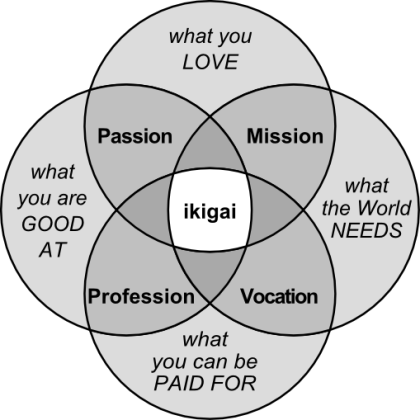
Here are a few high-level questions that you can ask yourself to get started or affirm the stage that you are in your life:
1. What do you love to do?
2. What are you great at?
3. What do you think the world needs?
4. What skills/traits do you think you can get paid for?
Embarking on your own entrepreneurial journey is as much about understanding the past as it is about shaping the future. The essence of starting any business is not founded upon the certainty of success, but in the courage to begin, the commitment to provide value, and the resilience to persevere. As you stand at the precipice of your adventure ahead, consider this not as the end of an article, but a single step towards your journey of a thousand miles.
“Your work is to discover your work and then with all your heart to give yourself to it.”
— Buddha
Disclaimer: This article aims to provide a concise overview of Business based on the information available at the time of writing. Due to the inherent complexities and the dynamic nature of the business world, it may not capture every facet or the latest developments. Readers are encouraged to conduct further research for the most current insights and to consider this piece as a starting point rather than an exhaustive analysis. The views expressed are based on the author’s interpretation and do not necessarily reflect the full scope of the business’s strategies or outcomes.

 Advance Fundamentals
Leave a reply to Navigating the Marketplace: A Strategic Guide to Industry Analysis – Advance Fundamentals Cancel reply